




Doppler in Anesthesia
December 11, 2025
Why we LOVE a Doppler in Anesthesia
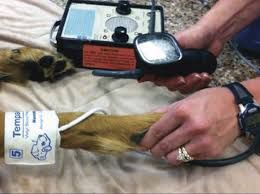
Things to Know:
- A Doppler value is generally considered to be the Systolic Arterial Pressure (SAP)
- Dopplers require the use of a Sphygnomometer and inflatable cuff. The width of the cuff should be: 40% of the limb circumference in dogs, and 30% of the limb circumference in cats. (I like to have a tape measure handy to eliminate the guess factor).
- A cuff that is TOO LARGE will falsely decrease the BP reading.
- A cuff that is TOO SMALL will falsely elevate the BP reading.
- Perform 4-6 readings and average the value to ensure replicable results.
- A Doppler BP reading does NOT provide a DAP (Diastolic Arterial Pressure) or MAP (Mean Arterial Pressure) in small animals - even cats.
- Transducer tubing should be directed away from the patient (down the leg), with the patient in lateral recumbency. The cuff is positioned on the limb which is at the level of the right atrium (Forelimb or hindlimb which is “up” not at the level of the table).
- Don’t overinflate the cuff- inflate to only 20-40 mmHg above when the pulse sound disappears. Overinflation can cause falsely elevated results.
Advantages: Doppler ultrasonography has several advantages when compared with other blood pressure monitoring techniques:
- Provides Audible pulse to aid in anesthesia monitoring
- Do not assume that if you can hear it, the blood pressure is good! You have to check it routinely and establish trends.
- Relatively easy to use.
- Affordable and readily available in most clinical settings.
- Appropriate to use in patients experiencing the following: significant hypotension, cardiac arrhythmias - tachycardia, bradycardia, arrhythmias, Vasoconstriction, Hypothermia
- More reliable in small animals (Neonates, cats, small dogs, exotics) than oscillometric techniques
- Can be used in awake patients for a pre-anesthetic BP reading
- Oscillometric techniques are not usually reliable with any form of patient movement.
Disadvantages:
- Obtaining Doppler measurements in patients with severe peripheral vasoconstriction (Hypovolemia, shock, severe hypothermia) can be difficult but this is true for all methods. A Doppler may fail to provide a reliable reading when the patient's Systolic Arterial Pressure (SAP) falls below 80-90 mmHg in a dog, and 60-70 mmHg in a cat.
- Monitoring patient trends is extremely important as intervention should occur before the SAP falls to this level.
Resources:
- https://todaysveterinarypractice.com/cardiology/todays-technician-blood-pressure-monitoring-from-a-nursing-perspective-part-2-blood-pressure-monitoring-techniques/#:~:text=75%20mm%20Hg-,Mean%20arterial%20pressure,TABLE%202.
- https://www.sciencedirect.com/science/article/abs/pii/S1467298719303174#:~:text=The%20agreement%20between%20ABPDoppler,1998).
- https://pmc.ncbi.nlm.nih.gov/articles/PMC7838334/
- https://www.vin.com/apputil/content/defaultadv1.aspx?pId=11290&id=4252629#:~:text=4%2C5,the%20direct%20blood%20pressure%20monitor.
"I am astounded with the service and care! Absolutely top notch service! Thank you so much for helping our Brew!!!"
-Katelin Buchanan
We love receiving feedback from our clients about their experiences. It is our mission to provide accessible pet healthcare to our community, while ensuring the entire process is as smooth as can be.
Read more
Tibial Plateau Leveling Osteotomy

Brain Games can be just as satisfying as a run in the park for your recovering pet.

Coming home after surgery is exciting!
